
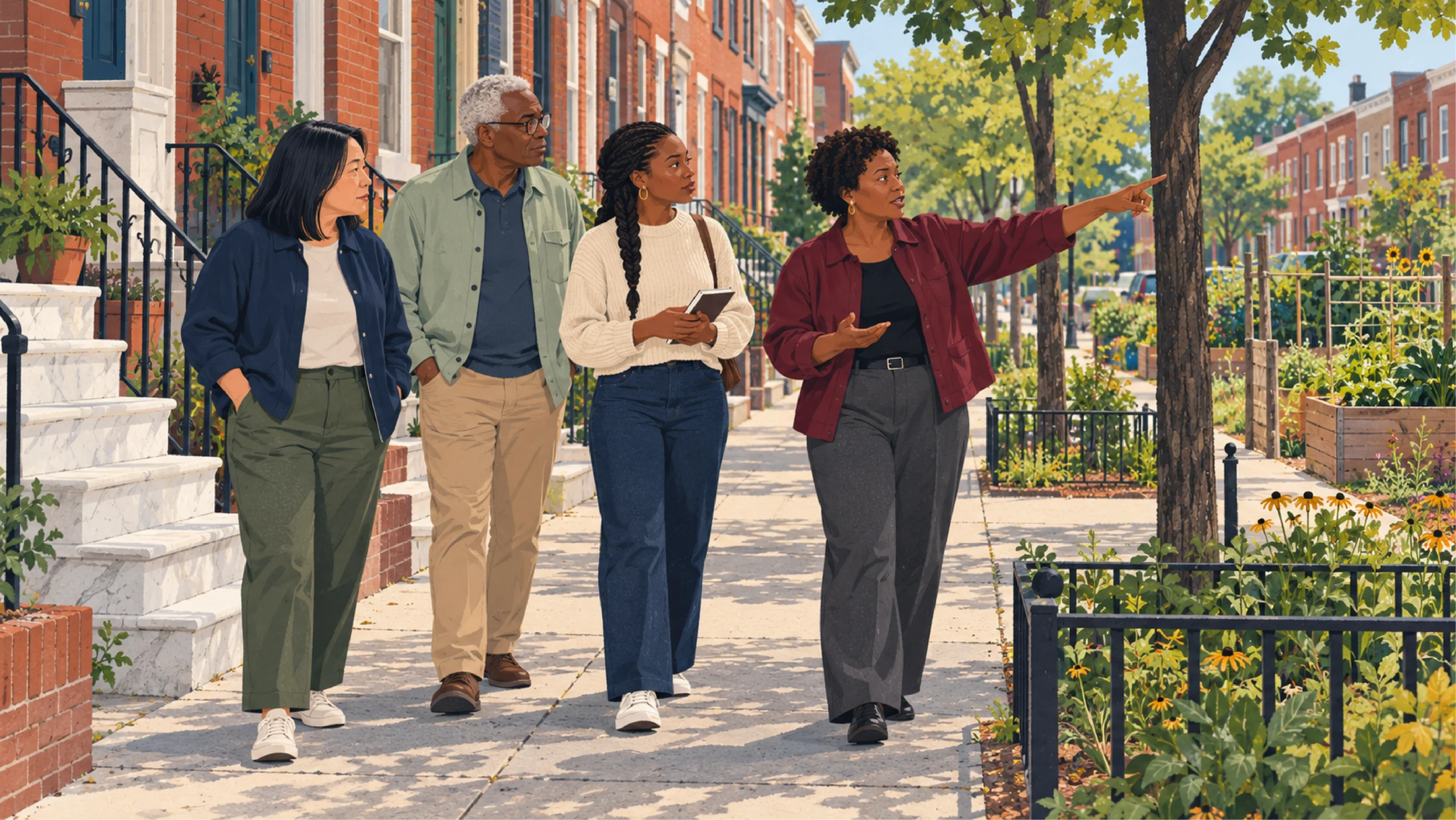
Listening sessions with Baltimore residents and community development practitioners show how local philanthropy can better support community-driven neighborhood investment. The post explains why resident leadership, sustained capacity building, flexible financing, shared expertise, and measures of resident well-being matter to effective philanthropy.
Understanding where local philanthropy can make a difference
Baltimore is changing, and much of that change is driven by public and private investments in housing, economic development, and neighborhood revitalization, often carried out by local nonprofits working alongside developers and residents. With so much activity underway, where can a local foundation do the most good with its money and other resources? How can it make strategic, sustainable investments that reflect what residents need and want for their neighborhoods, while attracting responsible investment from others?
To answer that question for itself, The Harry and Jeanette Weinberg Foundation commissioned Community Science to conduct a series of community listening sessions across Baltimore, primarily in West, East, and Northwest Baltimore. The Foundation wanted to understand what helps community development investments succeed and where philanthropy can better support neighborhood-led efforts. Through one-on-one and group conversations with community development practitioners and residents, we heard firsthand what has worked, where efforts have fallen short, and which challenges remain.
We then shared our findings at a community forum with the practitioners we interviewed, as well as at a funder-only meeting. Their reactions and reflections helped shape this blog. While the work was designed to guide the Foundation’s own investments, what we learned offers lessons for local philanthropy more broadly.
Why resident leadership and involvement matter in community development
Across the listening sessions, community development practitioners and neighborhood residents emphasized the importance of residents having a meaningful role throughout a development project’s life. Participants described the consequences when that role is missing: concerns and priorities left unaddressed despite dozens of meetings and surveys; housing residents cannot afford; buildings without the programs they need; broken promises as construction stalls; and decisions about their neighborhoods made without them.
Participants called for community-driven development, with ongoing communication rather than one-time engagement, real seats at the table where they can shape decisions, and ways to hold institutions accountable for their commitments. Many described being invited into planning conversations only to hear nothing afterward about what happened with their input or how projects moved forward.
What local philanthropy can do: Foundations can respond to this call through investments in community organizing and by developing authentic partnerships with resident-led organizations and public and private institutions involved in development. When considering grants and capital investments, they can ask how residents will influence decisions; how progress will be communicated regularly; how the investment will meet current residents’ needs, not just those of future residents, and how the project will support residents’ ability to remain in — or return to — their neighborhoods.
Invest in organizational and development capacities
Participants described a city with substantial expertise, committed neighborhood leaders, successful models, and multiple sources of public, private, and philanthropic capital. They also described uneven access to those resources and uneven capacity to implement community development strategies at a meaningful scale across Baltimore’s neighborhoods.
Closing these gaps requires two distinct kinds of capacity: the organizational capacity to lead and sustain effective, resilient nonprofits that keep the community’s interests front and center, and the development capacity to secure major investments and manage complex capital projects that respond to community priorities. Community-trusted organizations bring resident relationships, knowledge of neighborhood priorities, and varying levels of development experience. Experienced developers bring technical expertise, financial relationships, and the ability to navigate complex regulations and approval processes. Community-driven development depends on both kinds of capacity, but not every organization has, or needs to have, both.
At the community forum where we shared the findings, one participant stated explicitly that there is a difference between proficiency and expertise, and each of the above capacities demands expertise. Being proficient is not enough when the stakes include millions of dollars in investment and the future of a neighborhood. Building true expertise takes sustained investment and time, which is also why it is unrealistic to expect a single organization to develop deep expertise in both areas at once.
What local philanthropy can do: Foundations can respond on two fronts. In the near term, they can invest in organizations with demonstrated strengths in each area and broker partnerships that bring those strengths together. This can help capital reach more neighborhoods while ensuring residents shape the investments. Over the longer term, foundations can strengthen the infrastructure for community-driven development through sustained operating support for intermediary organizations that can provide technical assistance, facilitate peer learning, and develop stronger connections among community organizations, developers, lenders, and public agencies. The goal is a durable supportive ecosystem that helps organizations contribute their strengths, develop new capabilities, and work together to advance community-driven development across Baltimore.
Restructure community development financing
How funding is structured matters as much as when it arrives. Organizations can spend months assembling financing while covering planning, staffing, and predevelopment expenses, such as legal and architectural fees. Reimbursement-based funding adds another hurdle: organizations must pay project costs upfront and wait to recover them. Yet securing a loan to cover those costs may itself require cash reserves or other funding commitments. Organizations can find themselves needing money to access money even when funding has already been awarded. These barriers can cause them to lose properties, absorb rising costs, and struggle to retain staff. At the community forum, this point struck a chord: practitioners in the room readily recognized it as a challenge they had faced firsthand.
The report identified an opportunity to explore a housing and community investment accelerator that brings together philanthropic, public, and private resources. Flexible grants, early funding, and bridge financing could help organizations cover upfront costs and access longer-term financing. Alongside an accelerator fund, restructuring capital funding to allow for incremental advances or payments tied to project milestones could reduce the burden of fronting expenses. Participants emphasized that this should be a shared undertaking by foundations in Baltimore.
What local philanthropy can do: Foundations can coordinate investments and establish an accelerator fund. They can also work with community partners and public agencies to improve payment structures and share the risk of moving promising projects forward.
Connect existing expertise across the city’s community development sector
Baltimore already has organizations demonstrating promising approaches. The report highlighted efforts that include homebuyer counseling, home financing and renovation, and comprehensive approaches such as whole-block revitalization, community organizing, and the integration of housing, public space, and neighborhood amenities.
Access to that expertise, however, often depends on personal relationships.
What local philanthropy can do: A citywide infrastructure and support system could make practical advice, peer learning, and sustained technical assistance more widely available. As noted earlier, foundations can strengthen such an infrastructure and support system through sustained operating support for intermediary organizations that could fulfill these functions. The infrastructure and support system should recognize that trusted neighborhood organizations may contribute most effectively as a convener or partner, without becoming a developer itself.
Measure what matters to residents
Completed buildings and housing units are typical measures of progress, but they tend to favor large developers and overlook other meaningful gains in resident quality of life. Even when a project has not reached construction, community development efforts may be strengthening neighborhood stability, resident influence and power, wealth-building, jobs, small business growth, crime or violence reduction, and other indicators of quality of life. Without tracking these outcomes, funders risk overlooking progress and interpreting an unbuilt project as a failed investment.
What local philanthropy can do: For foundations, this means asking what changes residents want and see before, during, and after construction, and supporting the work needed to understand, assess, and document those changes over time.
Conclusion
The listening sessions funded by the Weinberg Foundation offer philanthropy a clear invitation, and a clear direction, for capital investment that revitalizes neighborhoods for current and future residents.
The findings landed well. At the community forum, practitioners, joined by several local foundations, saw what is working and what isn’t across the entire community development process, not just in their own neighborhoods. Many recognized their own experiences in the findings and confirmed what we had heard. The funders-only meeting was equally well attended. Funders valued the chance to compare notes and identify the issues most relevant to their foundations and roles, and they asked to keep the conversation going. Some even volunteered to host the next meeting.
One question at the forum stuck with us: Is what we heard in Baltimore typical of other places? The answer is yes. And that is the problem. The lessons are not new, yet philanthropy keeps repeating the same mistakes because it too often skips the step of learning first. Doing due diligence means understanding what has already been tried, what has failed, and what the people closest to the work already know, before the money goes out the door. This is why the Weinberg Foundation asked us to conduct the community listening sessions.
The path forward is clear. Build on the organizations and practices already showing promise. Fill the gaps in development financing. Coordinate resources around community priorities. Fund the ongoing work that helps residents shape, sustain, and benefit from investment. And invest, financially and otherwise, in the lasting infrastructure that community-driven development depends on.
About the Authors
Kien S. Lee, PhD, President of Community Science, has integrated the concept and practice of community, community capacity, and community and systems change into her work for almost three decades. She has studied and evaluated national, statewide, and local initiatives designed to bridge differences between communities with different histories and identities and find common ground; facilitate multi-sector collaboration to drive systems change; and strengthen organizations’ capacity to respond to the communities they serve and of which they are a part — all with the goal of fostering sense of community, advancing fair access to resources and opportunities for all, and promoting strong, healthy, and just communities.

David Chavis, PhD, consultant and former CEO/President of Community Science, has been a leader in the strategy design, implementation, and evaluation of complex community change initiatives for over four decades. The focus of his work has been assisting government agencies, foundations, and nonprofits in developing the infrastructure for building community capacity to address poverty, violence, substance use, and other social problems, as well as building community power. He’s also a leader in the theory, practice, and measurement of a sense of community and how it can bring divided communities and nations together as well as advancing health and justice.
Questions this post answers:
- What do Baltimore residents and community development practitioners want foundations to understand?
- How can foundations support community-driven development?
- Why do organizational capacity and development expertise both matter?
- What financing barriers slow neighborhood projects?
- How could a community investment accelerator help?
- What should foundations measure beyond completed buildings and housing units?